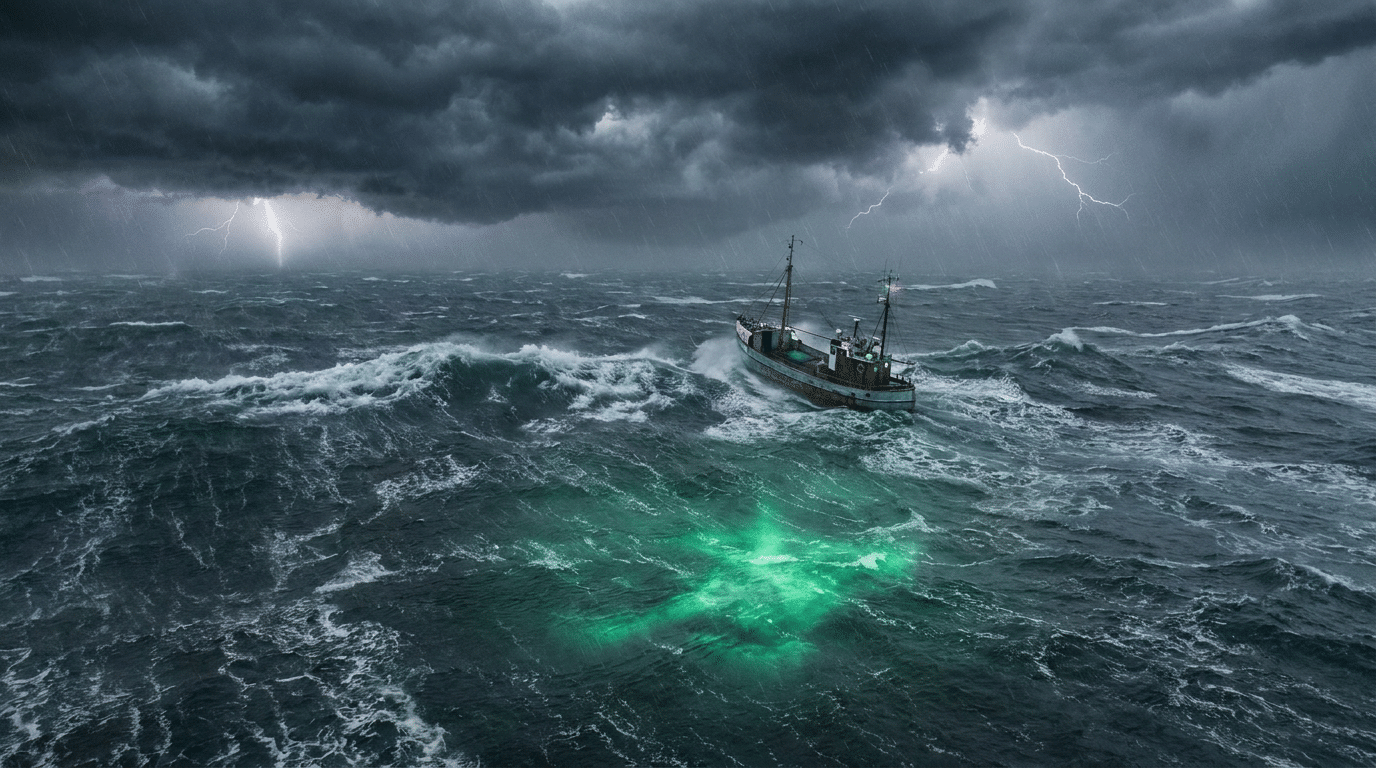
Few modern mysteries have become as famous as the Bermuda Triangle.
Stories describe ships disappearing without warning, aircraft vanishing from radar and crews encountering strange compass behavior. The supposed triangle is usually drawn between Florida, Bermuda and Puerto Rico, creating an image of a clearly defined danger zone in the western Atlantic.
But the geography is not actually precise, and the historical record is more complicated than the legend suggests.
The Bermuda Triangle is best understood as a case study in how real accidents, difficult environments, incomplete evidence and repeated storytelling can combine to create a powerful mystery.
There Is No Official Bermuda Triangle
The Bermuda Triangle has no universally accepted boundary.
Popular maps usually place its three points around southern Florida, Bermuda and Puerto Rico, but different writers have drawn different shapes and sizes.
This creates an immediate problem for statistics. If the boundaries can change depending on which incidents a writer wants to include, the supposed accident pattern becomes difficult to measure objectively.
A scientifically testable region needs a defined area and a defined population of events.
How Did the Legend Begin?
The modern Bermuda Triangle story developed largely through twentieth-century journalism and popular books.
Earlier accounts described individual maritime or aviation accidents without necessarily connecting them into a single supernatural pattern. Later writers grouped selected incidents together and presented them as evidence of an unusual zone.
Once the idea became familiar, subsequent disappearances were more likely to be interpreted through the same framework.
The legend therefore has a history of its own.
The Atlantic Is Not an Easy Place to Travel
The western North Atlantic contains powerful ocean currents, tropical storms, hurricanes and rapidly changing weather.
Weather conditions can deteriorate faster than an older ship or aircraft can respond, particularly when operators have incomplete forecasts.
Large waves can damage vessels, visibility can fall rapidly and strong winds can push a craft away from its expected position.
These hazards are not mysterious. They are simply dangerous.
Why the Gulf Stream Matters
The Gulf Stream is one of the most powerful ocean currents in the region.
When a vessel or aircraft is lost, floating debris does not necessarily remain near the location of the accident. Currents can transport material over substantial distances.
This complicates search operations.
An investigation conducted days after an incident may find wreckage far from the original position, while some objects may sink or become scattered.
The absence of a neat debris field can therefore create uncertainty without requiring anything unusual to have happened.
Navigation Was Harder Before Modern Technology
Modern travelers have access to satellite navigation, detailed digital charts, satellite weather observations and rapid communications.
Earlier mariners and aviators had far less information.
Navigation depended on instruments, charts, dead reckoning, celestial observations, radio signals and estimates of speed and direction. Errors could accumulate, especially during bad weather.
An aircraft or ship that deviated from its intended course could therefore become difficult to locate quickly.
What About Compass Anomalies?
Stories about the Bermuda Triangle often mention compasses behaving strangely.
Earth’s magnetic field is not uniform. Magnetic north and geographic north are not identical, and the difference varies by location and changes over time.
Navigation therefore requires appropriate charts and corrections.
There is no established evidence that the Bermuda Triangle contains a unique magnetic force capable of causing the disappearances attributed to it.
Flight 19 Became the Central Mystery
One of the most famous incidents associated with the Bermuda Triangle is the disappearance of Flight 19 in December 1945.
Five U.S. Navy Avenger aircraft departed from Florida on a training mission and failed to return. A rescue aircraft sent to search for them also disappeared.
The event became a cornerstone of Bermuda Triangle folklore.
The historical circumstances, however, include factors that investigators must consider before invoking anything paranormal: weather conditions, navigation difficulties, fuel limitations and the uncertainty created by the loss of the aircraft and crews.
Why Flight 19 Became So Powerful as a Story
Flight 19 contains exactly the features that make a mystery memorable.
Several aircraft disappeared together. The mission was military. Search efforts failed to recover definitive evidence. A second aircraft also vanished.
Those facts create genuine uncertainty.
But uncertainty does not identify a cause.
When evidence is incomplete, many explanations remain possible, including ordinary ones that cannot be confirmed because the physical evidence is missing.
Other Famous Cases
Other ships and aircraft have been connected to the Triangle over the years.
Some incidents involved severe weather. Others involved mechanical problems, navigational uncertainty or vessels that were already operating in difficult conditions.
Later retellings sometimes compress complicated investigations into a single sentence: “The ship vanished without a trace.”
The original records can be much less mysterious.
Why “No Wreckage” Is Not Extraordinary
At sea, finding wreckage can be difficult.
Ships can break apart. Some materials float while others sink. Currents disperse debris. Deep water makes recovery expensive and technically difficult.
If an accident occurs far offshore or under severe weather conditions, investigators may never recover enough evidence to reconstruct the entire event.
That is tragic, but it is not evidence of a supernatural mechanism.
The Statistics Problem
Perhaps the most important question is whether the Bermuda Triangle actually has an unusually high accident rate.
A region with many incidents is not necessarily unusually dangerous.
We need a denominator.
A heavily traveled region will naturally produce more accidents than a remote ocean area simply because more ships and aircraft pass through it.
Researchers would need to compare accident rates with other regions that have similar traffic volumes, weather conditions, geography and reporting quality.
Why the Denominator Matters
Imagine a road where thousands of cars pass every day. It will probably have more accidents than a quiet rural road simply because exposure is much higher.
Counting only the dramatic accidents without counting total journeys creates a misleading impression of risk.
The same principle applies to the ocean and aviation.
Selection Effects Build the Mystery
Once people expect the Bermuda Triangle to be mysterious, incidents that fit the story are more likely to be remembered.
Thousands of uneventful voyages through the same waters do not make compelling television.
A disappearance, especially one with incomplete evidence, does.
This is a classic selection effect: memorable cases become evidence for the pattern while ordinary cases disappear from the story.
Why the Legend Feels Stronger Over Time
Stories can accumulate details as they are retold.
A report that originally contained uncertainty may later be described as a disappearance under impossible circumstances. A navigation problem may become a “compass failure.” A storm may disappear from the summary because it makes the mystery less mysterious.
Each retelling can therefore make the story cleaner while making the historical record less visible.
What About Methane, Aliens and Lost Civilizations?
Many extraordinary explanations have been proposed for the Triangle, including methane releases, extraterrestrial activity, remnants of Atlantis and unusual magnetic phenomena.
Some of these ideas are based on real physical phenomena. Methane can escape from seafloor sediments in some regions, for example.
But a possible mechanism is not evidence that it caused a particular disappearance. A proposed explanation must fit the timing, location and physical evidence of actual incidents.
Can Methane Make Ships Sink?
Large releases of gas from the seafloor have been investigated as a possible mechanism in some hypothetical scenarios because gas bubbles can reduce the density of water.
However, the idea has not been established as the general explanation for Bermuda Triangle disappearances.
Again, the distinction between “physically possible” and “demonstrated in this case” is essential.
Why Weather Is Often the More Boring Explanation
Natural explanations are sometimes less satisfying because they do not produce a dramatic story.
A rapidly developing storm, navigational error or mechanical failure feels ordinary.
But ordinary hazards can produce extraordinary consequences.
At sea, a combination of heavy weather, poor visibility, equipment failure and human error can become fatal very quickly.
Does That Mean Every Case Is Solved?
No.
Some maritime and aviation incidents remain unresolved because the available evidence is insufficient.
An unresolved disappearance is a genuine historical uncertainty. Investigators may never know exactly what happened.
But “we do not know” is a valid conclusion. It does not require a paranormal explanation.
What Would Evidence for an Anomalous Zone Look Like?
A strong claim that the Bermuda Triangle has an unusual physical property would require measurable evidence.
Researchers would need to identify a phenomenon that occurs disproportionately within a defined region and demonstrate that it affects ships or aircraft in a reproducible way.
That evidence would then need to survive comparison with ordinary explanations such as weather, traffic density, navigation, mechanical failure and human factors.
No such anomalous mechanism has been established.
The Ocean Is Still Mysterious
Rejecting the supernatural Bermuda Triangle story does not make the ocean ordinary.
Much of the ocean remains difficult to explore. Weather can change rapidly. Deep water can hide wreckage. Currents can move evidence. Human decisions under pressure can produce unpredictable outcomes.
Real uncertainty is already enough to make maritime history fascinating.
The Bigger Lesson
The Bermuda Triangle demonstrates how three ordinary ingredients can produce an extraordinary legend:
- A hazardous environment in which accidents genuinely occur.
- Incomplete information that leaves some events unresolved.
- Selective storytelling that connects dramatic cases into a single narrative.
Once those ingredients combine, the pattern can feel stronger than the underlying statistics justify.
The Bermuda Triangle therefore tells us something important about evidence. A mystery is not automatically evidence of an unusual cause.
Sometimes the real mystery is how quickly uncertainty becomes a story—and how difficult it becomes to separate the original event from the legend built around it.
Curiosity Publication by Aadvik Agastya
Sources & further reading
Have a question about this topic?
Join fellow Qurons on the Quron Forum to ask questions, challenge ideas, share discoveries and explore further.
Discuss on Quron Forum