
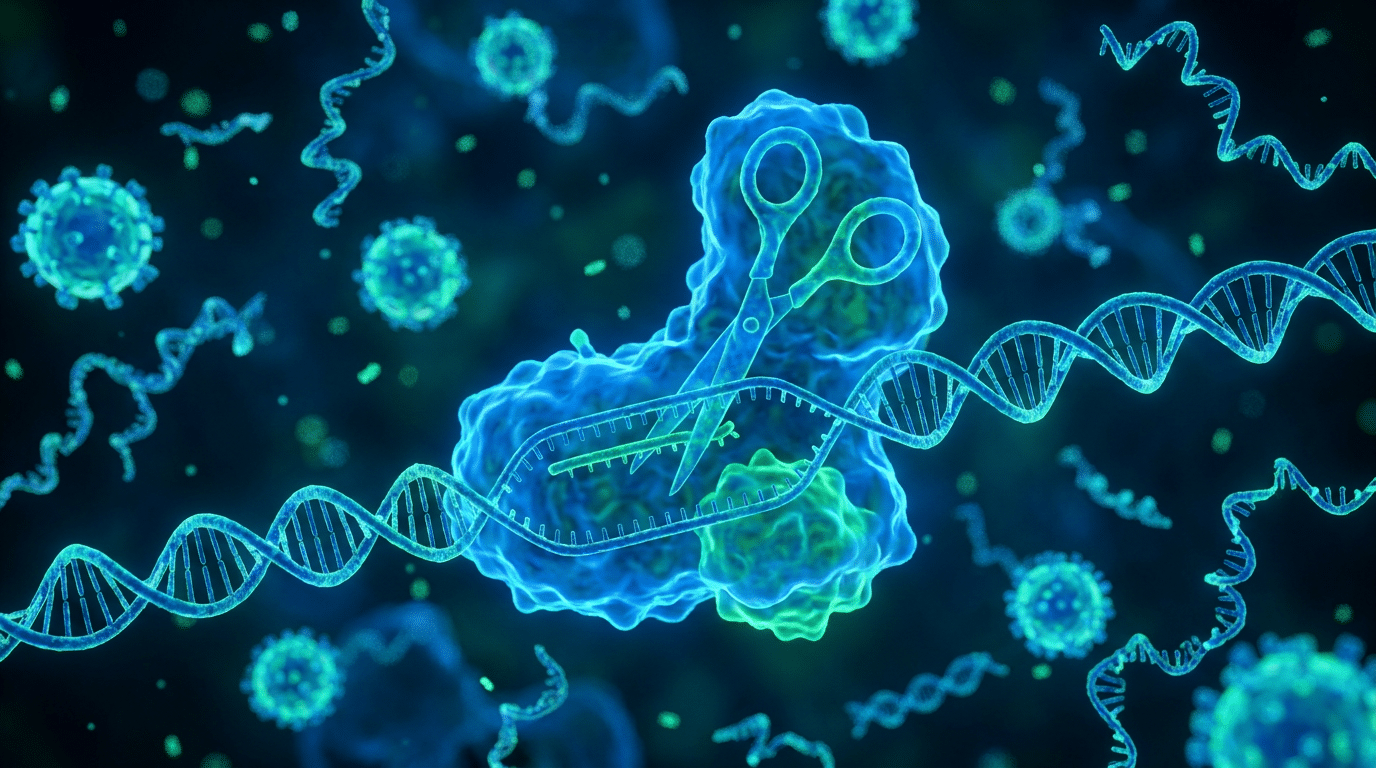
DNA is often described as the instruction manual of life. For most of modern biology, changing those instructions precisely was extraordinarily difficult. Scientists could study genes, sequence them and sometimes replace or insert genetic material, but targeted alteration was technically demanding.
CRISPR changed that landscape.
What began as part of a bacterial defense system became one of the most important tools in modern molecular biology. CRISPR-based technologies allow researchers to target particular DNA sequences and alter, disable or regulate them with a degree of programmability that earlier approaches often lacked.
But CRISPR is not a magical “find and replace” function for living organisms. DNA operates inside complex cells, genes interact with one another, and getting an editing system to the right cells can be as difficult as designing the edit itself.
CRISPR began as a bacterial defense system
The story starts with bacteria and the viruses that infect them. Bacteria can acquire and store fragments of viral genetic material in regions of their DNA associated with CRISPR sequences.
These stored sequences can help a bacterium recognize genetic material from a returning virus. CRISPR-associated proteins can then participate in targeting and destroying the matching genetic material.
In other words, CRISPR was not invented by genetic engineers. It evolved as part of a biological immune-like defense mechanism.
How scientists turned it into a gene-editing tool
The breakthrough came from understanding how CRISPR systems recognize their targets and then adapting that mechanism for controlled laboratory use.
In the widely used CRISPR-Cas9 system, a designed guide RNA helps direct the Cas9 protein toward a complementary DNA sequence. When the targeting requirements are satisfied, Cas9 can cut the DNA.
The remarkable part is that researchers can change the guide sequence to redirect the system to a different target.
Cutting DNA is only the beginning
CRISPR does not simply cut DNA and insert a replacement automatically. After a DNA strand is cut, the cell’s own repair machinery becomes important.
One repair pathway can reconnect the broken ends but may introduce small changes. Another strategy can use a supplied template to guide a more specific alteration.
Researchers can therefore use the same basic idea for different purposes: disrupting a gene, changing a sequence or modifying regulation.
Not all CRISPR editing works in the same way
The term “CRISPR” now describes a family of technologies rather than one single molecular procedure.
Some systems make double-stranded DNA breaks. Others, such as base editors, are designed to change particular DNA bases without making the same kind of double-stranded break. Prime editing is another approach intended to make a wider range of targeted sequence changes through a different molecular mechanism.
These newer tools illustrate an important direction in the field: improving precision and expanding what can be changed.
Why precision matters
A genetic edit is useful only if the intended change happens in the appropriate cells without producing unacceptable unintended consequences.
Researchers therefore look for off-target effects—changes at locations other than the intended target—as well as unwanted changes at or around the target site.
Modern design methods and improved editing systems can reduce these risks, but biological specificity is not the same as absolute perfection.
Delivery may be harder than the edit
Imagine developing a molecular tool that can make exactly the desired change. It still has to reach the relevant cells.
Researchers can use different delivery strategies depending on the tissue and disease. In some treatments, cells can be removed from the body, edited in a controlled laboratory environment and then returned to the patient. Other approaches aim to deliver editing machinery directly into the body.
Each method introduces its own challenges involving efficiency, immune responses, distribution and safety.
Why blood disorders became an important testing ground
Blood-forming cells provide a particularly interesting setting for gene editing because certain cells can be collected from a patient, modified outside the body and returned after appropriate preparation.
This strategy has been used in the development of CRISPR-based treatments for inherited blood disorders, including sickle-cell disease.
These therapies demonstrate an important transition: CRISPR is no longer only a laboratory research technique. In some carefully defined medical applications, gene editing has moved into clinical treatment.
What a CRISPR treatment actually involves
The popular image of a doctor injecting microscopic “genetic scissors” into a patient and instantly correcting a disease is misleading.
Some therapies involve collecting a patient’s cells, preparing and editing them under controlled conditions, testing the resulting cells, and then returning them to the patient as part of a complex treatment process.
The editing step may be technologically elegant, but the surrounding clinical procedure can be demanding.
Somatic editing versus germline editing
One of the most important distinctions in gene editing is between somatic and heritable changes.
Somatic editing changes cells in an individual patient. The alteration is generally intended to affect that person rather than become a genetic change passed to future children.
Editing embryos, eggs, sperm or cells that contribute to reproduction is different. Such changes could potentially enter the germline and be inherited by future generations.
This difference changes the ethical problem dramatically because future people would be affected without being able to consent.
Why germline editing is so controversial
The potential benefits are easy to imagine. If a specific disease-causing mutation could be corrected safely before birth, future generations might be spared the condition.
But the risks are also unusually difficult to contain. An unintended change could be inherited. A decision made for one generation could alter descendants. And once editing moves from treating disease toward selecting or enhancing traits, questions about social inequality and acceptable human modification become even more complicated.
Scientific uncertainty and ethical disagreement therefore intersect in this area.
CRISPR is also a research tool
Gene editing does not have to produce a therapy to be valuable.
Researchers can disable a gene in cells or organisms and observe what changes. This helps test the function of genes, investigate disease pathways and create experimental models.
CRISPR can therefore accelerate basic biology even when no clinical application is intended.
CRISPR and cancer research
Cancer is not a single genetic disease. Tumors can contain complex combinations of mutations and evolve over time.
Gene-editing tools can help researchers investigate how particular genes affect cancer-cell behavior, identify potential drug targets and engineer experimental systems for studying disease.
Using CRISPR to understand cancer is therefore different from using it as a direct “cure.” The research tool can reveal mechanisms even when clinical editing remains difficult.
Agriculture is another major frontier
Plants can also be genetically edited. Researchers have explored changes related to disease resistance, nutritional characteristics, growth and environmental tolerance.
Gene editing can sometimes produce changes that resemble naturally occurring genetic variation, although the biological and regulatory questions depend on the particular organism and edit.
Regulatory systems differ among countries, so an edited crop may be treated differently in different jurisdictions.
CRISPR does not make biology simple
One of the biggest misconceptions is that once scientists can edit genes, they can control biological traits at will.
Many traits are influenced by numerous genes and by environmental conditions. Changing one gene can have effects elsewhere in a biological system, and the same genetic change can behave differently depending on cellular context.
CRISPR increases the precision of an intervention. It does not eliminate the complexity of the organism being edited.
The problem of unintended consequences
Safety assessment involves more than checking for classic off-target edits. Researchers also need to consider changes at the target site, immune responses, delivery effects, the behavior of edited cells and what happens over long periods.
This is especially important when a genetic alteration is permanent or persists for the lifetime of a cell lineage.
Long-term follow-up is therefore a central part of evaluating genetic therapies.
Can gene editing be completely precise?
“Precise” should be understood comparatively rather than absolutely.
A modern editing system can be dramatically more targeted than older genetic-engineering methods, but a biological system still operates within a complex environment. Researchers continually improve guide design, molecular specificity, delivery and methods for detecting unintended changes.
The scientific goal is not perfection in an abstract sense. It is to make the intended therapeutic benefit outweigh the risks to an acceptable degree for a particular application.
The ethical question is not simply “Can we?”
CRISPR changes the ethical conversation because technical capability can arrive before society has agreed on its boundaries.
Questions include who gets access to expensive therapies, how risks should be evaluated, how germline applications should be governed, what counts as treatment rather than enhancement, and how future generations should be represented in decisions affecting them.
There are no purely technical answers to all of these questions.
A new relationship with heredity
For most of human history, inherited genetic variation was something populations experienced rather than deliberately designed. Modern biotechnology does not give us total control over heredity, but it gives us an unprecedented ability to intervene in particular genetic sequences.
That makes CRISPR historically unusual. It is simultaneously a research instrument, a medical technology, an agricultural tool and a source of questions about the limits of human intervention.
The power—and the limitation—of CRISPR
CRISPR does not allow scientists to rewrite an organism like a document. It provides programmable molecular tools for making specific interventions in DNA and related biological processes.
Its importance comes from the combination of targeting, adaptability and improving precision.
The next stage of the field is therefore unlikely to be simply “more editing.” It is likely to involve better delivery, greater control, more reliable detection of unintended changes and clearer evidence about which interventions actually help patients.
Editing life without fully controlling it
CRISPR has changed what is technically possible in biology. But the technology also reveals how much remains difficult.
Genes operate in networks. Cells respond to their environments. Organisms develop through interactions among DNA, physiology and surroundings. Editing one sequence can therefore be precise while the resulting biological consequences remain complicated.
The real revolution is not that humanity has gained unlimited control over life. It is that we have acquired a much finer instrument for intervening in living systems—and now have to learn how to use it responsibly.
Editing a genome is easier to describe than to control
CRISPR is often described as molecular scissors, but therapeutic genome editing is more complicated than simply cutting DNA at a chosen location. Researchers must deliver the editing machinery to the right cells, guide it to the intended sequence, make the desired change and then determine what happened elsewhere in the genome.
This is why delivery has become one of the central engineering problems in gene editing. Different tissues require different delivery strategies, and a treatment that works in cultured cells may behave differently inside a living organism.
Why temporary CRISPR activity can be an advantage
For some applications, researchers do not want the editing machinery active for longer than necessary. A short exposure can be enough to make a lasting DNA change while potentially reducing opportunities for unintended editing.
Recent research has therefore explored non-viral delivery systems alongside more established viral approaches. A 2025 review of the clinical landscape described a growing interest in transient and non-viral delivery strategies for in-vivo CRISPR therapies. citeturn0search12
Off-target effects are only one part of the safety problem
It is tempting to imagine safety as a simple question of whether CRISPR cuts the wrong DNA sequence. In reality, researchers also have to consider the size and type of the intended edit, the biological response of treated cells, delivery to unintended tissues and the consequences of editing a particular cell population.
Better guide design, improved enzymes, careful sequencing and controlled delivery can reduce risks, but no single technique eliminates every uncertainty. Safety therefore has to be evaluated for each therapeutic application rather than assumed from the CRISPR platform as a whole.
Somatic editing and heritable editing are fundamentally different
Editing cells in a patient’s body is generally described as somatic editing. The resulting changes are intended to affect that individual rather than future generations.
Editing embryos or reproductive cells raises a different set of scientific and ethical questions because the changes could potentially be inherited. The distinction is important because the technical ability to edit DNA does not automatically answer the question of where editing should be permitted.
The future of CRISPR is becoming more precise
CRISPR research has expanded beyond the original idea of cutting DNA and letting the cell repair it. Researchers are developing approaches that can make more controlled changes, alter gene activity without permanently changing the underlying sequence, or target particular genetic variants.
The long-term significance of genome editing may therefore come not from one miraculous “genetic scissors” technology, but from an expanding toolkit in which different editors are matched to different biological problems.
Curiosity Publication by Aadvik Agastya
Sources & further reading
- National Human Genome Research Institute — CRISPR Fact Sheet
- Nobel Prize — The CRISPR-Cas9 Genetic Scissors
- U.S. FDA — Gene therapies for sickle-cell disease
Have a question about this topic?
Join fellow Qurons on the Quron Forum to ask questions, challenge ideas, share discoveries and explore further.
Discuss on Quron Forum