The idea sounds like science fiction: imagine moving a cursor, speaking a sentence or controlling a robotic arm without moving your hands. Instead of pressing a button, the system responds to patterns of activity in your brain.
That is the goal of a brain-computer interface (BCI)—a system that records neural activity and translates useful patterns into commands for an external device. BCIs do not normally read arbitrary private thoughts. Most are much more specific: they are trained to recognize patterns associated with an intended movement, selection or communication command.
Even that narrower achievement is remarkable. It creates a new communication pathway between the nervous system and technology.
What is a brain-computer interface?
A BCI connects brain activity to an external system without requiring the normal muscular pathway. In everyday movement, the brain sends signals through the nervous system to muscles. A BCI attempts to intercept information from neural activity and use it to control software, a robotic device, a prosthesis or another interface.
The basic chain can be described as:
- record: capture neural activity;
- process: remove noise and identify useful features;
- decode: estimate the user’s intended action;
- control: translate the estimate into a device command;
- feedback: give the user information that helps refine control.
That final step is important. A useful BCI is not simply a brain-to-machine wire. It can become a learning system in which both the algorithm and the user adapt.
The brain communicates through electrical and chemical activity
Neurons communicate using electrical changes across their membranes and chemical signals at synapses. Large populations of neurons can therefore produce measurable patterns of activity.
A BCI does not observe the entire brain. It records particular signals from particular locations using a particular measurement technique. The challenge is to determine which aspects of those signals contain information relevant to the task.
For example, a person imagining moving a hand can produce neural activity related to movement planning and execution. A decoder can be trained to associate aspects of that activity with a desired computer command.
Invasive BCIs: closer to the neural source
Invasive systems place electrodes inside the skull, sometimes close to individual neurons or groups of neurons. Because the electrodes are physically closer to neural tissue, they can capture signals with greater spatial detail than many non-invasive techniques.
This can support more precise control, including experimental systems designed to decode movement or speech-related signals.
The cost is obvious: implantation requires surgery. Long-term reliability, tissue responses, infection risk, electrode durability and signal stability are major engineering and medical considerations.
Electrocorticography sits between extremes
Some systems place electrodes on the surface of the brain rather than penetrating neural tissue. This approach can provide relatively high-quality signals while avoiding some of the limitations associated with individual penetrating electrodes.
It still requires neurosurgery, so it remains very different from an ordinary consumer wearable.
Non-invasive BCIs
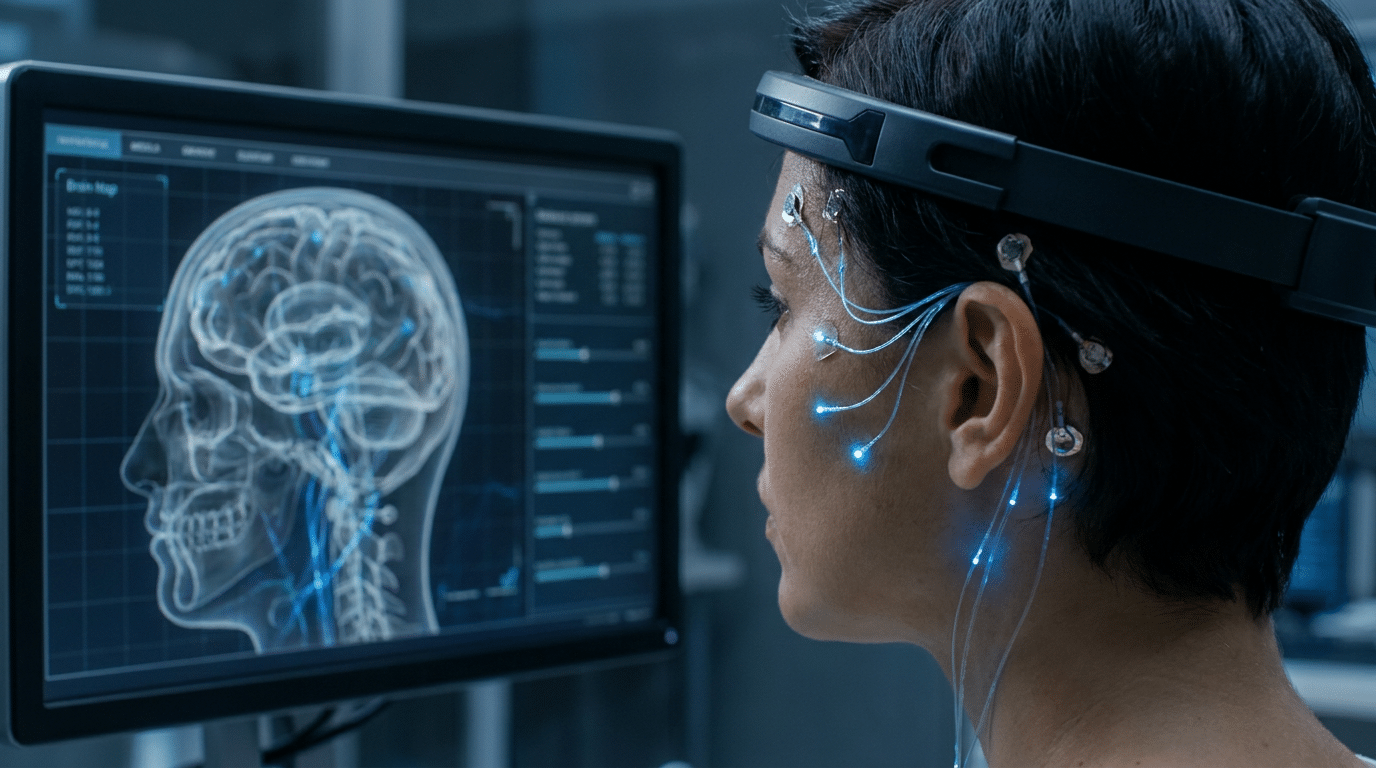
The most familiar non-invasive approach is electroencephalography (EEG), in which sensors placed on the scalp measure electrical activity associated with populations of neurons.
EEG avoids brain surgery and can be relatively portable. But the skull and other tissues alter and blur the signals before they reach the sensors. The resulting measurements therefore have less precise information about the location of the underlying neural activity.
Other techniques can measure changes associated with brain activity using different physical signals. Each method involves trade-offs among spatial resolution, temporal resolution, portability, cost and safety.
How does the decoder learn what the user intends?
Suppose a BCI is intended to move a cursor. The user might imagine moving the cursor in different directions while the system records neural activity.
Machine-learning algorithms can search for statistical relationships between the neural measurements and the intended movement. After training, the decoder can estimate the intended direction from new neural data.
This sounds straightforward until one considers how variable the brain is.
Why calibration is such a major problem
Neural signals are not fixed labels. The activity associated with an action can vary with attention, fatigue, motivation, electrode position, task design and learning.
Two people can produce different neural patterns while attempting the same movement. The same person can also produce somewhat different patterns on different days.
BCIs therefore often require calibration and adaptation. Better algorithms can reduce the burden, but a robust interface still has to cope with a biological system that changes over time.
BCIs are not ordinary mind readers
The phrase “mind reading” can create unrealistic expectations. Most present-day BCIs are designed around constrained tasks.
A system might decode an intended direction, identify a selection from a set of choices or infer speech-related movements. That is very different from scanning someone’s brain and discovering every private thought, memory or emotion.
Even when speech decoding becomes highly capable, the system is interpreting measurable neural patterns within a trained context. It is not automatically gaining unrestricted access to the contents of a person’s mind.
Communication may be one of the most important applications
For a person who cannot reliably speak or move, communication can become extremely difficult. A BCI could provide an alternative route to a computer that does not depend on conventional muscle control.
Research has demonstrated increasingly sophisticated approaches to decoding attempted or imagined speech-related activity. The goal is not simply faster typing. For some patients, restoring a communication channel can have profound practical importance.
However, experimental success in a controlled research setting does not mean that a universal clinical system is already available. Accuracy, speed, training requirements, hardware and long-term reliability all matter.
Controlling robotic limbs
Another major research direction connects neural signals to robotic or prosthetic devices. The user attempts a movement, the BCI decodes the intention, and the external device performs the corresponding action.
The most sophisticated systems aim for a closed loop. Instead of simply sending commands outward, the user receives sensory or visual feedback about what the device is doing.
That feedback matters because the brain is designed for continuous interaction with the body and environment. Learning to control an external device becomes easier when the system provides information that can be incorporated into the user’s ongoing control strategy.
The brain and machine can adapt together
One of the most interesting aspects of BCIs is that adaptation occurs on both sides. The decoder can learn from neural data, while the user can learn to produce neural patterns that work better with the decoder.
This makes the interface less like a static translator and more like a shared control system.
It also explains why performance can improve with practice. The user is not merely operating a finished machine; the nervous system can learn how to use a new pathway.
Why reliability remains difficult
A laboratory demonstration can work under carefully controlled conditions. A practical technology must work repeatedly, safely and predictably.
Real-world systems face movement artifacts, changing neural signals, electrode shifts, hardware failures, algorithm drift and differences between users. An implant also has to function within a living body for potentially many years.
For medical applications, reliability is not a cosmetic feature. A device that works brilliantly for a short experiment but becomes unstable or difficult to maintain may not translate into routine care.
What BCIs could mean for rehabilitation
BCIs may also be used as part of rehabilitation rather than simply replacing a lost function. Neural activity associated with attempted movement can potentially be connected to assistive devices or stimulation systems, allowing patients to practice and reinforce pathways involved in motor recovery.
The precise therapeutic value depends on the condition and the design of the intervention. BCI research therefore spans engineering, neuroscience, rehabilitation medicine and clinical trials.
Neural data creates a new privacy problem
Brain data is unusually sensitive because it may contain information related to intention, attention, responses to stimuli or other aspects of a person’s neurological state.
That does not mean today’s BCIs can decode every private thought. It means that as decoding improves, the question of who controls neural data becomes increasingly important.
Users may need clear rules governing data collection, storage, sharing, commercial use and deletion. Security also matters: a device connected to the nervous system should be treated as more than an ordinary consumer gadget.
Consent becomes especially important
Medical BCIs can create unusual consent challenges. A person may depend on the system for communication, yet the same system may collect sensitive information about their neural activity.
Researchers and developers therefore have to consider not only whether a device works, but whether the user understands what data it records and how that data will be handled.
Could a BCI change our sense of agency?
When a machine responds to neural activity, questions about control become interesting. If the system makes an incorrect prediction and moves a robotic arm, who or what caused the movement?
In practice, these problems can often be addressed through interface design, confirmation mechanisms and user-controlled safeguards. Philosophically, however, BCIs offer a fascinating test of what we mean when we say that a person intends an action.
The science-fiction version is probably not the near-term reality
Popular fiction often imagines complete mind uploading, instant telepathy or a direct interface through which arbitrary thoughts can be transmitted into a computer.
Current BCI research points toward something more concrete and, in some ways, more useful: communication for people with severe disabilities, control of assistive devices, restoration of movement and increasingly natural interaction between neural systems and technology.
Those achievements do not require decoding the entire mind.
Where the field is heading
Future BCIs may become more adaptive, less invasive, more portable and better able to provide sensory feedback. Better algorithms could reduce calibration requirements, while improved materials could make long-term interfaces more stable.
Researchers are also exploring systems that combine neural recording with stimulation, creating bidirectional interfaces rather than one-way brain-to-machine channels.
The difficult question is not whether brains and machines can communicate. Early BCIs have already demonstrated that they can. The question is how natural, reliable and safe that communication can become.
A new kind of interface
The most important lesson from BCIs may be that the boundary between biological and digital systems is not as absolute as it once appeared.
A thought does not have to become a sentence in the ordinary way. A movement does not necessarily have to pass through a muscle. With the right sensors and algorithms, patterns of neural activity can become commands for a machine.
We are still far from a technology that simply reads a person’s mind. But we are already learning something remarkable: the brain can become an input device.
From laboratory signal to usable communication
The most important progress in brain-computer interfaces is not the idea that a machine can read a brain signal. Researchers have been doing that in limited forms for years. The harder problem is turning noisy neural activity into a useful, continuous interface that works for a person over time.
Recent speech neuroprosthesis research illustrates the challenge. Implanted electrodes can record activity associated with attempted speech, while machine-learning systems learn relationships between those signals and words or speech sounds. In 2025, an NIH-highlighted system produced streaming audible speech from cortical activity, while other work demonstrated increasingly rapid and accurate decoding. citeturn0search1turn0search0
Why artificial intelligence matters to BCIs
Neural signals do not arrive as clean instructions such as “say this sentence.” They are complex patterns that vary between people and can change over time. Machine-learning models can learn statistical relationships between those patterns and intended movements, words or commands.
This makes a BCI partly a personalization problem. A decoder trained for one participant cannot simply be assumed to work identically for another. Calibration, signal quality, electrode placement and long-term stability all matter.
BCIs are moving beyond speech alone
Communication is broader than words. In September 2026, an NIH-funded study reported a BCI that decoded speech and upper-body gestures together into control of a personalized virtual avatar in participants with paralysis. The work illustrates an emerging direction: restoring a richer layer of communication rather than merely producing text. citeturn0search2
That distinction matters because facial expression, gesture, timing and tone carry information that a text-only interface loses.
The hardest problem may be long-term reliability
A laboratory demonstration can succeed under carefully controlled conditions. A practical device has to work repeatedly, comfortably and safely, with changing signal quality and minimal assistance.
A 2026 systematic review of AI-based brain-to-speech research found substantial variation across studies and highlighted the gap between promising demonstrations and broad clinical validation. citeturn0search4turn0search5
What BCIs can—and cannot—read
The phrase “mind reading” creates the wrong expectation. Most successful systems decode specific signals in a controlled task after training. They are not general-purpose machines that can freely read every private thought.
That distinction is crucial. The future of BCIs may involve communication, movement restoration, accessibility and new forms of human-computer interaction, but progress will depend on solving the practical problems of accuracy, safety, privacy, durability and user control.
Curiosity Publication by Aadvik Agastya
Sources & further reading
- National Institute of Neurological Disorders and Stroke — Brain-Computer Interface
- National Institutes of Health — Brain-Computer Interface Research
- Nature — A high-performance neuroprosthesis for speech
Have a question about this topic?
Join fellow Qurons on the Quron Forum to ask questions, challenge ideas, share discoveries and explore further.
Discuss on Quron Forum