
Advaita Vedanta begins with a deceptively simple problem: what exactly is the self?
We normally speak as though the answer is obvious. “I” am this body. “I” remember my past. “I” have thoughts, emotions, preferences and a personal history. Yet every one of these features changes. The body changes, thoughts appear and disappear, memories can be lost, moods shift and beliefs evolve.
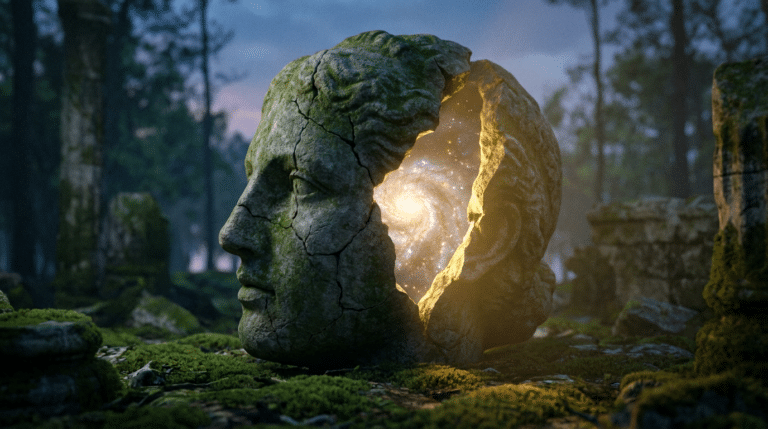
Advaita asks what remains when we investigate this changing collection of experiences. Its radical answer is that the deepest self, Atman, is not ultimately separate from Brahman, the ultimate reality.
This is what Advaita—literally “not two”—is trying to express. It is not simply the claim that everything is connected. It is a philosophical argument about the nature of reality, knowledge and the apparent separation between observer and observed.
Where Advaita Comes From
Advaita Vedanta developed within the broader Vedanta tradition, whose philosophical foundations draw heavily on the Upanishads, the Bhagavad Gita and the Brahma Sutras.
The tradition has a long intellectual history rather than beginning with a single philosopher. Adi Shankara, generally dated to the early medieval period, became its most influential systematic interpreter. His commentaries argued for a non-dual reading of the Upanishadic teachings and engaged in detailed debate with rival philosophical schools.
That historical context matters. Advaita was not an isolated mystical idea. It developed through argument, commentary and debate about scripture, knowledge, perception, causation and liberation.
What Does “Not Two” Mean?
Ordinary experience presents the world as divided.
There is a subject who sees and objects that are seen. There is a person who thinks and thoughts that are experienced. There is an internal world and an external world. Advaita does not deny that these distinctions operate in everyday life.
Its deeper claim is that they are not ultimately independent realities.
In the Advaita view, Brahman is the ultimate reality, while the individual self is not a separate substance existing independently from it. The realization that Atman is Brahman is therefore not the discovery of a new object. It is a transformation in understanding what the self has always been.
Why Investigate the Self?
The investigation begins with ordinary experience.
You can notice a sensation in your body. You can notice an emotion. You can remember a thought you had five minutes ago. You can even observe the fact that your attention has shifted.
Advaita uses this observation to ask a difficult question: if something can be known or observed, is it identical to the knower?
The body can be observed. Thoughts can be observed. Feelings can be observed. Memories can be observed.
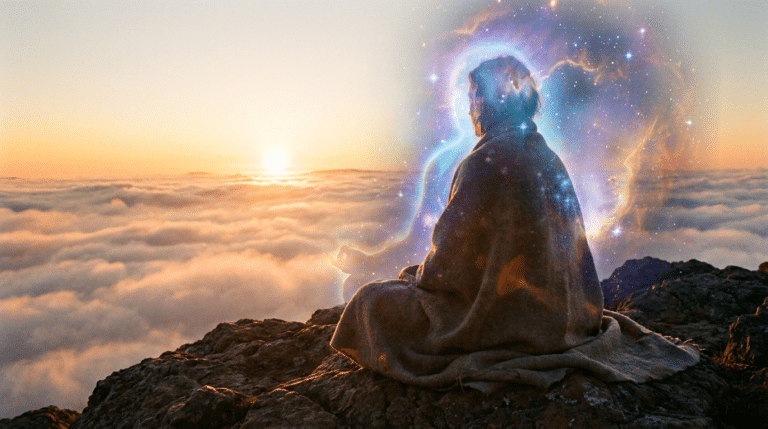
The philosophical investigation then turns toward the “witness”—the awareness in which these experiences appear.
The Witness and the Problem of the Observer
The idea of a witness can sound simple, but it quickly creates a philosophical puzzle.
If I say “I am aware of my thoughts,” Advaita asks what kind of “I” is being referred to. The thought is an object of awareness. The emotion is another object. The bodily sensation is another. What is the status of the awareness in which all of them are known?
Advaita’s answer is not that there is a tiny observer sitting somewhere inside the brain. That would simply create another object that could itself be observed.
Instead, awareness is treated as fundamental to experience rather than as one more object inside experience.
What Is Brahman?
Brahman is difficult to define because Advaita treats ultimate reality as beyond the ordinary categories used to describe objects.
The Upanishadic tradition uses both positive and negative approaches. Brahman can be discussed through concepts such as being, consciousness and fullness, but it is also approached by saying what it is not.
This is important because Brahman is not supposed to be a giant object somewhere in the universe. It is not another planet, energy field or cosmic person occupying a location.
In Advaita, Brahman is the underlying reality in relation to which all distinctions and experiences are understood.
Atman and Brahman
The famous Advaita proposition is that Atman, the deepest self, is Brahman.
At first this can sound like a claim that every individual’s personality is literally the entire universe. That is not the intended argument.
The distinction is between the empirical personality—the body, memories, preferences and social identity—and the deeper self understood as consciousness rather than as a changing object.
When Advaita says Atman is Brahman, it is therefore challenging the assumption that consciousness belongs to a fundamentally separate individual entity.
Maya Is More Complicated Than “The World Is an Illusion”
One of the most persistent misunderstandings of Advaita is the statement that “the world is fake.”
That is far too crude.
The world is experienced. Actions have consequences. People suffer and experience pleasure. Ethical responsibilities operate within ordinary life. Advaita does not require someone to deny the practical reality of the world.
The philosophical distinction concerns ultimate reality. The world of distinctions is not considered independently ultimate in the same sense as Brahman.
The term maya is therefore better approached through the problem of appearance and misapprehension than through the simple English word “illusion.”
The Rope and the Snake
A classic philosophical analogy illustrates the problem.
Imagine seeing a rope in dim light and mistaking it for a snake. The fear is real in the sense that the person genuinely experiences fear, but the snake itself was never present.
When the light reveals the rope, the mistaken interpretation disappears.
Advaita uses such examples to explain how ignorance can produce an experience of separateness that appears convincing until knowledge changes the interpretation.
The analogy is not meant to say that the physical universe is literally a hallucination. It illustrates how an appearance can be experienced as real while being misunderstood at a deeper level.
How Does Advaita Explain Ignorance?
If the deepest self is already Brahman, why does ordinary experience feel so strongly divided?
Advaita explains this through avidya, often translated as ignorance or lack of true knowledge.
Ignorance does not simply mean lack of information. A person can know enormous amounts of factual information and still misunderstand the nature of the self.
The problem is existential rather than merely intellectual. Identification with the body, mind and social identity creates the sense of being a separate individual who must secure happiness from an external world.
Knowledge as the Route to Liberation
Advaita places unusual emphasis on knowledge, but the word can be misleading if understood as collecting facts.
Liberating knowledge is supposed to transform the way the self is understood. Traditional discussions describe processes of hearing the teaching, reflecting upon it and deeply contemplating its meaning.
Ethical discipline and mental steadiness are also important because a distracted or unstable mind has difficulty sustaining philosophical inquiry.
The goal is moksha, liberation from ignorance and the cycle of mistaken identification.
Is Advaita Saying “Nothing Matters”?
Not in its classical form.
Advaita distinguishes between different levels or orders of reality rather than simply declaring everyday life meaningless. Within ordinary experience, actions, relationships and ethical obligations remain consequential.
The fact that ordinary distinctions are not ultimately independent does not imply that one can ignore suffering or behave without responsibility.
Indeed, Advaita’s ethical and preparatory disciplines assume that conduct matters for the development of a mind capable of inquiry.
How Advaita Differs From Other Vedanta Schools
Advaita is one major Vedanta interpretation, not the only one.
Other Vedanta traditions developed different accounts of the relationship between the individual self, God and the world. Vishishtadvaita, associated with Ramanuja, emphasizes a qualified non-dualism in which distinctions remain meaningful within a larger unity. Dvaita, associated with Madhva, maintains a stronger distinction between God and individual souls.
These differences demonstrate that Indian philosophy cannot be reduced to a single doctrine of “everything is one.” There was sustained debate over what the Upanishads meant and how reality should be understood.
The Epistemological Problem
Advaita also raises a question about how knowledge is possible.
How can a finite mind know something described as ultimate reality? If the ordinary subject-object distinction is itself part of the problem, what kind of knowledge could reveal what lies beyond it?
Classical Indian philosophy developed sophisticated discussions of valid means of knowledge, including perception, inference and testimony, with different schools assigning different roles to each.
Advaita gives scriptural revelation a particular role in communicating what ordinary perception cannot directly establish, while reasoning is used to clarify and defend the interpretation.
Why Modern Science Is Not a Proof of Advaita
Modern readers sometimes connect Advaita with quantum physics, neuroscience or theories of consciousness. Such comparisons can be intellectually stimulating, but they should not be mistaken for historical or scientific proof.
Physics investigates measurable physical systems using mathematical models and experiments. Neuroscience investigates relationships between neural processes and behavior or experience. Advaita is making a metaphysical and epistemological argument about self and ultimate reality.
The subjects can overlap around questions such as consciousness and observation, but their methods are different.
Advaita and the Modern Problem of Consciousness
There is nevertheless a genuine philosophical point of contact with contemporary debates about consciousness.
Modern philosophy of mind continues to ask why physical processes are accompanied by subjective experience and how a unified sense of self arises from a changing brain.
Advaita starts from a different direction. Instead of asking how consciousness emerges from matter, it questions whether consciousness should be understood as something that emerges from an independent physical substrate at all.
That does not make Advaita scientifically confirmed. It means that it offers a radically different starting point for thinking about the relationship between consciousness and the world.
The Paradox of Describing the Undescribable
Advaita faces a fascinating problem: it uses concepts to argue that ultimate reality cannot be captured by ordinary concepts.
Language divides. We say “self” and “world,” “subject” and “object,” “knower” and “known.” Yet the philosophy ultimately challenges those very distinctions.
This is why Advaita often uses paradox, negation and carefully qualified statements. The teaching is not intended simply to provide a definition of Brahman as though Brahman were another object in the universe.
Why the Philosophy Still Feels Surprisingly Modern
Advaita can feel contemporary because its central questions have not disappeared.
What makes you the same person across decades? Is the self a thing or a process? Are thoughts the self, or are they experiences happening to a self? What is the relationship between awareness and the contents of awareness?
Modern psychology and neuroscience approach these questions experimentally. Advaita approaches them through philosophical analysis and contemplative inquiry.
The answers are not interchangeable, but the persistence of the questions explains why the tradition continues to attract attention.
The Deeper Question
Advaita Vedanta is ultimately not asking people merely to believe that everything is one. It is asking them to investigate the assumption that the observer is a separate, independently existing entity.
That investigation begins with something ordinary: noticing experience.
You can observe your body. You can observe sensations. You can notice thoughts. You can remember emotions. You can even notice the changing sense of identity that ties these experiences together.
Then comes the difficult question: what is the “I” that knows all of this?
Advaita’s answer is that the deepest self is not another object waiting to be discovered. It is consciousness itself, ultimately identical with Brahman.
Whether one accepts that conclusion or not, the philosophical investigation is unusually powerful because it turns the ordinary certainty of “I know who I am” into a problem that has no easy answer.
Curiosity Publication by Aadvik Agastya
Sources & further reading
Have a question about this topic?
Join fellow Qurons on the Quron Forum to ask questions, challenge ideas, share discoveries and explore further.
Discuss on Quron Forum