
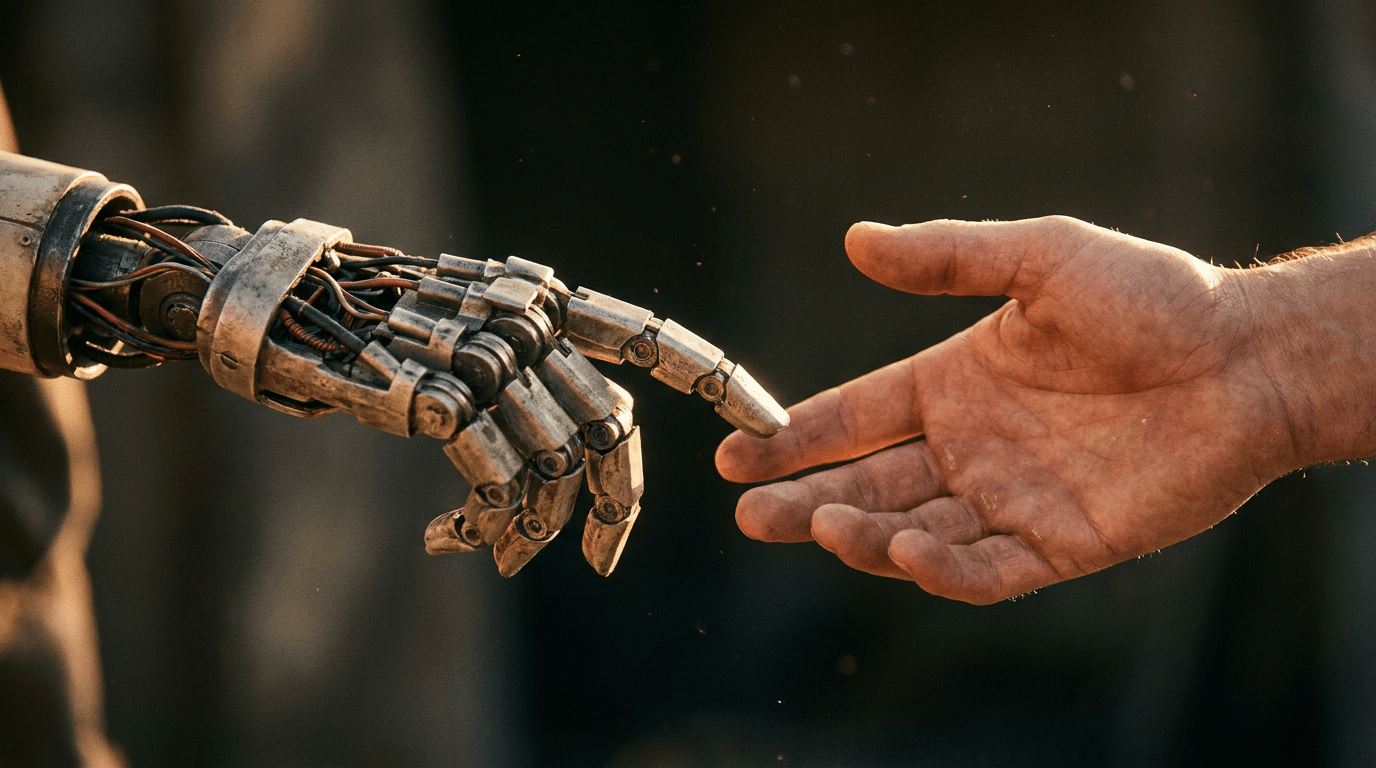
Artificial intelligence can now write essays, generate images, translate languages, summarize documents, analyze data, write software and interact through natural conversation. That makes it tempting to describe AI as a sudden arrival.
It was not.
The current wave is the result of decades of work in computer science, statistics, neural networks, optimization, data engineering and specialized hardware. What changed recently was the combination of scale, algorithms and computing power—and the emergence of systems that can perform many different information-processing tasks from a common model.
The most important question is therefore not simply whether machines are becoming “intelligent.” It is what happens when software can perform an expanding range of cognitive tasks at very low marginal cost?
Artificial intelligence has a long history
Early AI research explored symbolic reasoning, search, logic and systems designed around explicit rules. These approaches could solve carefully defined problems but struggled with the messy variability of the real world.
Machine learning changed the emphasis. Instead of programming every rule explicitly, researchers developed systems that could learn statistical relationships from examples.
Neural networks became one of the most important approaches. Inspired loosely by the structure of biological nervous systems, artificial neural networks consist of interconnected computational units whose parameters can be adjusted during training.
Why deep learning changed the field
Neural networks were not new, but their capabilities grew dramatically when larger datasets, faster hardware and improved training techniques became available.
Deep learning uses networks with many layers to learn increasingly complex representations. In image recognition, for example, early layers can respond to simple patterns while deeper layers can represent more complicated structures.
Instead of relying entirely on human-designed features, the system can learn useful representations from data.
The importance of scale
Modern AI systems often involve enormous amounts of training data and computational resources. Increasing model size alone does not guarantee useful behavior, but scale can allow systems to learn patterns that smaller models cannot represent as effectively.
Hardware also matters. Graphics processing units and other specialized accelerators can perform huge numbers of mathematical operations in parallel, making large-scale training practical.
The result is a feedback loop: better hardware enables larger experiments, larger experiments reveal useful techniques, and those techniques make even more capable systems possible.
The transformer changed language AI
A major technical development was the transformer architecture, introduced in 2017. Transformers use mechanisms such as attention to model relationships among elements of a sequence.
For language, this makes it possible to process context in ways that proved highly effective for training large models. Systems based on transformer architectures eventually became the foundation for many modern language and multimodal models.
The significance was not simply that computers could generate sentences. It was that one model could learn broad statistical representations from enormous datasets and then be adapted to many tasks.
What is a foundation model?
A foundation model is trained on broad data and can subsequently be adapted or prompted for many applications. A single model may support writing, summarization, question answering, coding, classification or other tasks.
This differs from the older image of AI as a collection of separate programs, each built for one narrow purpose.
Foundation models do not eliminate specialization, but they change how software can be developed. Instead of creating every capability from scratch, developers can build applications around a general model and add specialized tools, data or workflows.
Why language models can appear surprisingly intelligent
Large language models learn statistical patterns in sequences of text. During training, the model adjusts enormous numbers of parameters so that it becomes increasingly good at predicting relationships within language.
The resulting behavior can be far more flexible than simply retrieving memorized sentences. A model can combine learned patterns, follow instructions, transform information and produce novel-looking responses.
This is one reason the systems can appear to reason. But fluent behavior should not automatically be interpreted as proof of human-like understanding, consciousness or common sense.
Prediction can produce useful generalization
A common misconception is that a language model must contain a database entry for every sentence it can generate. Instead, the model represents statistical relationships learned across its training process.
This allows it to construct responses that were not explicitly present as complete sentences in the training material.
But generalization has a weakness: the model can also combine patterns in ways that produce plausible nonsense.
Why AI sometimes hallucinates
Generative AI systems can produce statements that sound authoritative but are false. This behavior is often called hallucination.
The underlying problem is partly a mismatch between generation and truth. A generative model is trained to produce useful or likely outputs under particular objectives; it is not automatically a perfect fact-checking system.
Modern systems can use retrieval, external tools, citations, structured data and verification processes to reduce errors. But none of these techniques makes factual reliability automatic.
For high-stakes information, independent checking remains important.
AI is becoming multimodal
Human communication is not limited to text. We use images, sound, video, diagrams, speech and physical interaction.
Modern AI systems increasingly work across several modalities. A model may analyze an image, interpret spoken language, generate text and interact with software within the same broader workflow.
This matters because real-world tasks rarely arrive in a single clean format. A doctor, engineer, researcher or student may need to combine documents, images, measurements and natural language.
Is AI actually understanding?
This is one of the most difficult conceptual questions.
An AI system can manipulate symbols, recognize patterns and produce remarkably appropriate responses. But whether that constitutes “understanding” in the same sense as human understanding depends partly on how understanding is defined.
Some researchers emphasize observable capabilities and functional performance. Philosophers have raised deeper questions about semantics, intentionality, embodiment and subjective experience.
There is no need to resolve that philosophical debate in order to recognize that AI systems can already perform many useful tasks.
AI is already part of ordinary life
The AI revolution did not begin with chatbots. Machine-learning systems have been used for years in search, recommendation engines, spam filtering, fraud detection, speech recognition, image classification, navigation and many other applications.
What has changed is the visibility and flexibility of the newest generation of generative systems.
AI is increasingly becoming a general-purpose layer inside software rather than a hidden component that performs one narrow prediction.
What happens to work?
The effect of AI on employment is unlikely to be a simple story of “robots replace humans.” Jobs are collections of tasks, and those tasks vary greatly.
A system may automate one part of an occupation while making another part more valuable. It can also change how work is organized: a person might spend less time drafting, searching or formatting and more time reviewing, deciding, communicating or supervising.
Some tasks may disappear, new tasks may emerge, and the productivity of existing workers may change.
The distribution of those effects across occupations, industries and workers remains an empirical question rather than something that can be predicted from the existence of AI alone.
AI can also augment human capability
A useful way to understand AI is as a tool that can extend human capability. It can help a researcher explore a large literature, help a programmer inspect code, help a student practice concepts, or help a business automate repetitive information processing.
The quality of the result still depends on the workflow around the model. Human review, good data, clear objectives and appropriate verification can make a major difference.
AI and scientific research
AI is increasingly being used in scientific workflows, including prediction, pattern recognition, protein and molecular research, image analysis and experimental planning.
Its value can be especially high when the amount of data exceeds what humans can examine manually.
But scientific usefulness requires more than generating a plausible answer. Researchers need reproducibility, measurements, uncertainty estimates and independent validation.
AI changes the information environment
Search engines, recommendation systems and generative models influence what information people encounter and how they encounter it.
That creates an unusual situation: AI can simultaneously make information easier to access and make convincing misinformation cheaper to produce.
Provenance, source quality and verification therefore become more important as synthetic content becomes easier to generate.
Bias is partly a data problem and partly a system problem
AI systems learn from data, and datasets can contain historical inequalities, missing information or distorted representations. Even a model trained on broad data can behave differently depending on how it is prompted, fine-tuned or deployed.
Bias is therefore not a single defect that can always be removed with one technical fix. It can enter through data collection, labeling, objectives, model design, deployment and the decisions made by people using the system.
AI safety is broader than avoiding incorrect answers
Safety includes reliability, privacy, security, misuse, unintended behavior and the consequences of deploying a system in an unsuitable context.
An incorrect movie recommendation is inconvenient. An incorrect automated decision in medicine, finance, employment or infrastructure can be far more serious.
This is why evaluation has to be matched to the stakes of the application.
Why governance matters
AI systems can affect access to information, employment, finance, education, security and public services. Technical performance is therefore only one part of the question.
Governance can involve transparency requirements, privacy protections, safety testing, accountability mechanisms, auditing and rules governing particular applications.
Different jurisdictions and institutions are experimenting with different approaches. The important point is that technical capability does not determine social outcomes by itself.
The energy and infrastructure question
Large AI models require substantial computational infrastructure for training and, at scale, for serving users. Data centers consume electricity and require cooling, networking equipment and specialized hardware.
This does not mean that AI’s environmental effects can be summarized by a single number. Energy use depends on the model, hardware, workload, data center and electricity source.
As AI becomes more widespread, efficiency will matter alongside capability.
What AI still cannot do reliably
AI systems can be impressive and still fail unpredictably. They may misunderstand ambiguous instructions, rely on incorrect assumptions, struggle with unfamiliar situations or generate confident but unsupported conclusions.
They also do not automatically possess human goals, lived experience or common sense simply because they can produce fluent language.
The most useful attitude is neither to dismiss these systems as glorified autocomplete nor to assume that every impressive output represents human-level reasoning. Their capabilities are real, but uneven.
The real revolution
The most consequential change may be economic rather than philosophical.
For much of modern history, producing high-quality cognitive work required large amounts of human time. AI is beginning to reduce the cost of performing some forms of information processing.
That could change how organizations operate, how people learn, how software is produced and how scientific research is conducted.
What comes next depends on deployment
The same technology can be used for accessibility, education and scientific research, or for fraud, manipulation and unreliable automated decisions.
There is no technological law that determines which outcome society will get. Institutions, incentives, regulation, competition and individual choices all influence how AI is deployed.
The question that remains
Artificial intelligence is not one technology and it is not a single trajectory. It is a collection of methods whose capabilities are expanding at different rates.
The interesting question is therefore not whether AI will “take over everything.” It is where machines will become dependable enough to change the way particular tasks are performed—and where human judgment will remain essential.
The AI revolution is already underway. Its final shape will depend less on a mythical moment when machines suddenly become human, and more on millions of practical decisions about what we ask machines to do.
Curiosity Publication by Aadvik Agastya
Sources & further reading
- NIST — Artificial Intelligence
- OECD — Artificial Intelligence
- Vaswani et al. — Attention Is All You Need
- Nature — AI and scientific discovery
Have a question about this topic?
Join fellow Qurons on the Quron Forum to ask questions, challenge ideas, share discoveries and explore further.
Discuss on Quron Forum